

DHA-Licensed Clinic · Dubai
Restore Your Hair.
Reclaim Your Confidence.
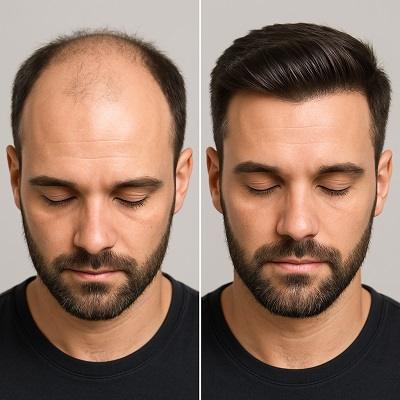
Advanced FUE & DHI hair transplants in Dubai — natural-looking results, permanent density, performed by board-certified surgeons with 5,000+ successful cases.
✓ DHA-Regulated Surgeons
✓ Lifetime Free PRP Included
✓ Unlimited Grafts Package
Hair Transplant Packages
FUE Hair Transplant From AED 8,000
DHI Hair Transplant From AED 10,000
Unlimited Grafts Package AED 9,999 ✦
Free PRP with Package Lifetime Included
Consultation FREE
Get My Free Hair Analysis → 5,000+ Successful Transplants
98% Patient Satisfaction
15+ Years Combined Experience
4.9★ Google Rating
DHA Licensed License No. 62929125-001 · Al Wasl Road, Umm Suqeim 2, Dubai
What Is a Hair Transplant?
Permanent Hair Restoration, Backed by Science
A hair transplant is a minimally invasive surgical procedure that permanently relocates healthy hair follicles from a donor area (typically the back or sides of the scalp) into thinning or bald regions. Unlike topical treatments or medications, transplanted follicles are genetically resistant to hair loss — making results truly permanent.
At Medicure Aesthetics, our DHA-licensed surgeons use the latest FUE and DHI techniques to deliver natural-looking density with no linear scarring and minimal downtime. Each treatment plan is custom-designed around your hair loss stage, graft count, and aesthetic goals.
✔ For Men & Women
All hair loss patterns treated
✔ Beard Transplants Too
Restore beard density & hairline
✔ No Linear Scar
FUE leaves no strip scar
✔ 3–5 Day Recovery
Return to work within days
Our Techniques
Proven Hair Transplant Methods in Dubai
Every technique is selected based on your unique hair loss pattern, donor density, and aesthetic goals during a free consultation.
Most Popular
FUE Hair Transplant
Individual follicles extracted one-by-one for maximum naturalness — no strip scar, faster healing.
- 2,500–4,000 grafts per session
- No linear scar left behind
- Return to work in 3–5 days
- Ideal for norwood stages 2–5
Advanced
DHI Hair Transplant
Direct implantation with a Choi pen gives surgeons precise control over angle, depth, and direction.
- Choi pen for direct implantation
- Higher graft survival rate
- Maximum density in one session
- Ideal for refined hairline work
For Beards
Beard Transplant
Restore, define, or fill sparse beard, goatee, or moustache patches with permanent follicle transfer.
- Natural beard density restored
- Custom beard line design
- Minimal downtime
- Permanent, natural results
Non-Surgical
PRP Hair Treatment
Platelet-rich plasma from your own blood injected into the scalp to stimulate dormant follicles.
- No surgery, no downtime
- Stimulates natural growth
- Ideal pre- or post-transplant
- Included free in packages
Advanced Therapy
GFC Hair Treatment
Growth factor concentrate therapy — a next-generation evolution of PRP with higher concentration of growth factors.
- Higher potency than standard PRP
- Faster visible results
- Ideal for early hair thinning
- Zero downtime required
Classic Method
FUT Hair Transplant
Strip-method transplant for patients needing the highest graft volumes in a single session.
- Up to 5,000+ grafts in one go
- Cost-effective for large areas
- Best for advanced hair loss
- Scar concealed by hair
Not sure which is right for you?
Also explore our non-surgical hair loss treatments — ideal for early-stage thinning or as a complement to transplant surgery.
The Procedure
What to Expect on Treatment Day
1
Free Consultation
Hair loss assessment, graft count estimation, and personalised treatment plan.
2
Donor Shaving & Prep
Donor area trimmed, scalp cleaned, and local anaesthesia administered.
3
Follicle Extraction
Individual follicular units carefully extracted using micro-punch tools.
4
Channel Creation
Micro-incisions made in recipient area with precise angle and direction control.
5
Graft Implantation
Follicles placed one-by-one for natural density and hairline design.
Expected Results
Your Hair Growth Timeline
Results are gradual and permanent. Here's what to expect month by month after your transplant.
Initial Shedding
Transplanted hairs shed — this is completely normal and expected.
New Growth Begins
Fine new hair starts breaking through the scalp surface.
Noticeable Density
Significant improvement in coverage and density becomes visible.
Full Results
Transplanted hair blends naturally — permanent, full-density result achieved.
Transparent Pricing
Hair Transplant Cost in Dubai
All packages include free consultation and aftercare. Final pricing confirmed after your personalised hair analysis.
| Treatment | Graft Range | Technique | Price Range | Includes |
|---|---|---|---|---|
| FUE Hair Transplant | 1,000–4,000 | Follicular Extraction | AED 8,000–18,000 | Consultation + Aftercare |
| DHI Hair Transplant | 1,500–3,500 | Choi Pen Implant | AED 10,000–22,000 | Consultation + Aftercare |
| Unlimited Grafts Package Best Value | Unlimited | FUE / DHI | AED 9,999 | Free Lifetime PRP + Head Wash |
| FUT Strip Transplant | 2,000–5,000+ | Strip Method | AED 8,000–20,000 | Consultation + Aftercare |
| Beard Transplant | 500–2,000 | FUE | AED 6,000–15,000 | Consultation + Aftercare |
| PRP Hair Treatment | N/A | Injection | AED 900–1,500/session | Consultation |
※ Prices are indicative. Exact cost depends on graft count, technique, and complexity. Contact us for a free personalised quote.
Why Medicure Aesthetics
Dubai's Trusted Hair Transplant Clinic
DHA-Licensed Surgeons
All procedures performed by Dubai Health Authority-licensed specialists — not technicians.
Latest Technology
Micro-motor extraction tools, Choi pens, and sapphire blades for maximum precision.
Natural Hairline Design
Artistic hairline planning tailored to your face shape, age, and existing hair pattern.
Complete Aftercare
Prescribed medications, PRP sessions, and ongoing check-ins included in your package.
Transparent Pricing
No hidden fees. Clear pricing from your first consultation — no surprises on treatment day.
Prime Dubai Location
Located on Al Wasl Road, Umm Suqeim 2 — easily accessible from across Dubai.
Patient Reviews
Real Results, Real Stories
Verified patient reviews from our Google Business Profile.
★★★★★
"If you're looking for the best hair transplant in Dubai, I highly recommend Medicure. The procedure was smooth, and I'm already seeing great, natural-looking results. The team's professionalism truly stood out."
SA
Saqlain Ahmed
FUE Transplant · Verified Patient
★★★★★
"I was nervous before my hair transplant but the doctor explained everything thoroughly. Six months on and the density is incredible. Could not be happier with the results at Medicure Aesthetics."
MH
Mohammed Hassan
DHI Transplant · Verified Patient
★★★★★
"The unlimited grafts package was unbeatable value. Lifetime PRP included and the results at 9 months are beyond what I expected. The team is extremely professional and caring throughout."
RK
Rahul Kumar
Unlimited Package · Verified Patient
Explore More
Other Treatments at Medicure Aesthetics
Our clinic covers a full spectrum of aesthetic and medical treatments under one roof.
Cosmetic Injectables
Botox, lip fillers, dermal fillers & more
Laser Treatments
Hair removal, pigmentation, skin tightening
Cosmetic Surgery
Rhinoplasty, blepharoplasty, liposuction
Weight Loss
GLP-1, Mounjaro, Ozempic injections
Skincare Treatments
HydraFacial, acne, anti-ageing facials
Dentistry
Dental aesthetics and oral health care
IV Drip Therapy
Energy, immunity, anti-ageing drips
Dermatology
Skin conditions, exosomes, PRF therapy
FAQ
Frequently Asked Questions
Hair transplant costs in Dubai range from AED 8,000 to AED 30,000 depending on the technique, number of grafts needed, and the clinic. At Medicure Aesthetics, our Unlimited Grafts Package starts at AED 9,999, which includes lifetime free PRP sessions and a free consultation — making it one of the most comprehensive packages in Dubai.
Hair transplants are permanent. The transplanted follicles are taken from the back and sides of the scalp, which are genetically resistant to DHT — the hormone responsible for male and female pattern hair loss. Once these follicles are implanted, they grow for life. With proper care and complementary treatments like PRP, your results will last a lifetime.
The procedure is performed under local anaesthesia, so patients feel minimal discomfort during surgery — typically a slight pressure sensation rather than pain. Post-procedure soreness is mild and managed with prescribed pain relief. Most patients are surprised by how comfortable the experience is.
Initial shedding of transplanted hair is normal in weeks 2–4. New growth begins around months 3–4, with significant visible improvement by month 6. Full, mature results are typically achieved between 9–12 months post-procedure, when transplanted hair has fully integrated with your natural hair.
The ideal age is generally after 25, once your hair loss pattern has stabilised. Transplanting too early risks needing further procedures as hair loss continues. Our surgeons perform a thorough assessment to determine whether your hair loss is stable enough for surgery, and may recommend non-surgical treatments first for younger patients.
FUE (Follicular Unit Extraction) leaves tiny, circular micro-dot scars spread across the donor area that are virtually invisible even with short hair. FUT (strip method) leaves a thin linear scar on the back of the scalp, usually concealed by surrounding hair. DHI, being a derivative of FUE, also leaves no visible linear scar.
The number of grafts depends on the size of your thinning area and the density you desire. Mild recession may need 1,000–2,000 grafts; moderate baldness typically requires 2,000–3,500 grafts; advanced cases may need 4,000 or more. Our surgeons provide a precise graft estimate during your free consultation. Our Unlimited Grafts Package removes any worry about graft limits.


